Mediation Center: An Expanded Timeline

45 years of building mediation in Minnesota (1981–Present)

1981
Founding

In 1981, we started as a small project of the Hennepin County Bar Association, built on an idea that felt almost radical at the time. Under our first director, John Wolf, we opened with a simple premise: disputes could be settled without a winner and a loser, and without an adversarial process that so often damaged relationships even after a case was closed.

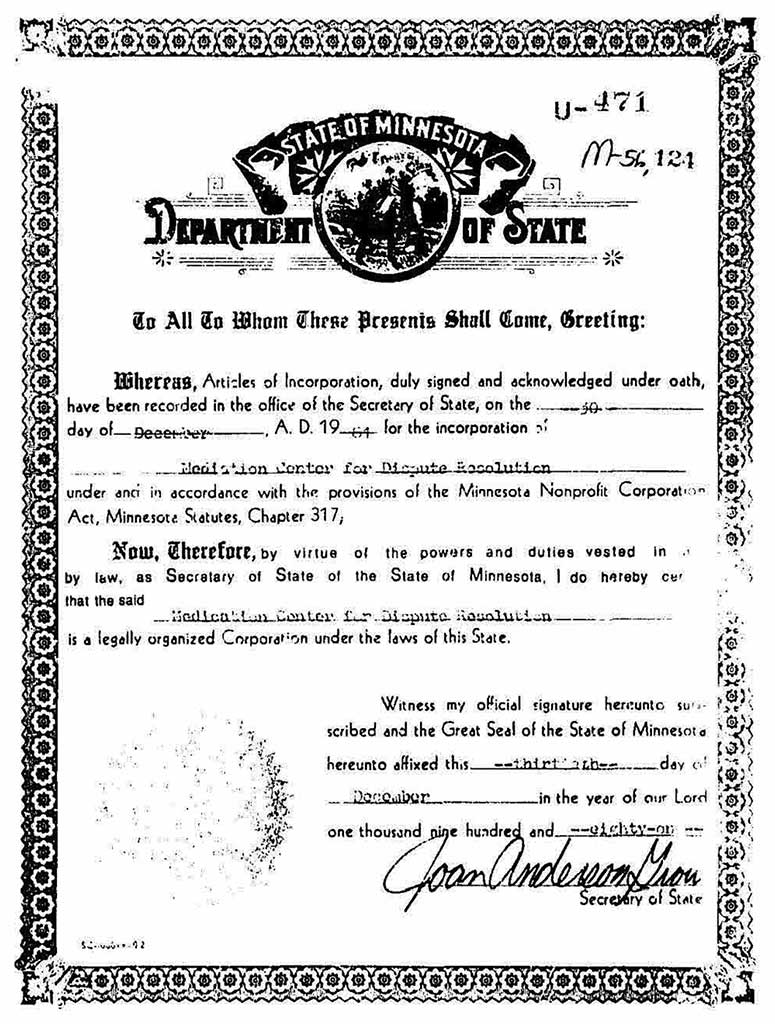
On December 30, 1981, we incorporated as an independent Minnesota nonprofit, Mediation Center for Dispute Resolution. The Center operated from 430 Marquette Avenue in downtown Minneapolis.

Mediation Center started by training volunteer lawyers as mediators and taking on neighborhood disputes that police and courts had neither the time nor the tools to resolve. We partnered with community organizations like the Hawthorne Area Community Council and worked alongside the Minneapolis Police Department and the city's crime prevention program.

“Nobody knew what mediation was in 1981,” Gary Weissman, one of our earliest trainers, recalls.

1982
Early Growth

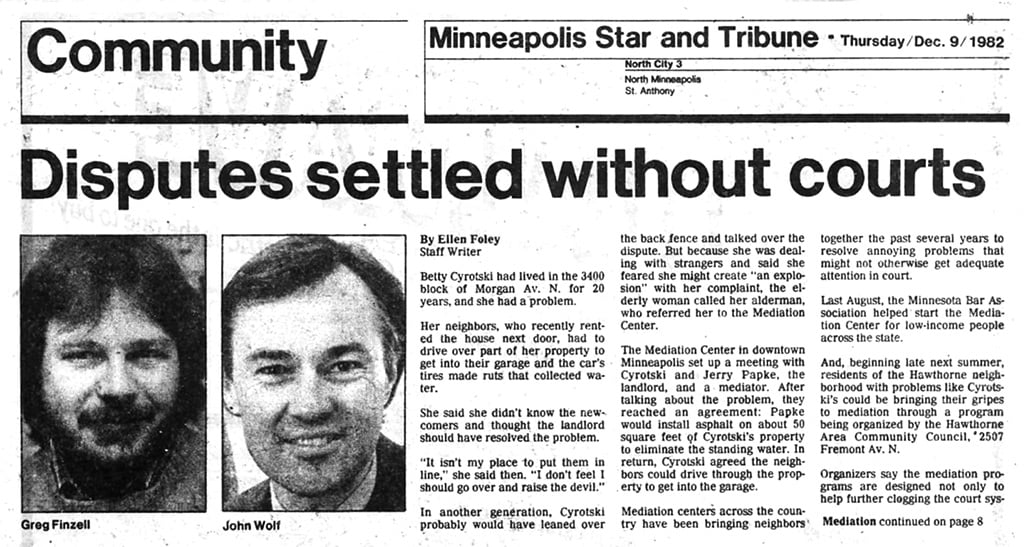
“There is a need for an alternative to the adversarial process,” Wolf told the Star Tribune in 1982, describing a system where neighbors, family members, and business partners could work through hard topics without a court battle standing between them.

Minneapolis Star Tribune covers Mediation Center in 1982, featuring founding director John Wolf and mediator Greg Finzell.

By the following summer, our work was funded by the Minnesota State Bar Foundation and the Hennepin County Bar Foundation, so that everyday disputes could be resolved without the cost of going to court. Our caseload grew to include everything from noisy neighbors to property line disputes. Mediation centers around the country pointed to programs like ours as a model.

The Center ran a Juvenile Offender Mediation Program, a court-diversion effort for first-time young offenders funded by a State of Minnesota grant through the Supreme Court Judicial Planning Committee. It began in the western suburbs and expanded to Minnetonka, Edina, Golden Valley, and other communities. Larger operating grants came from the Northwest Area Foundation and the Bush Foundation through mid-1985.

1980s
Statewide Expansion

That kind of grassroots momentum soon caught the attention of the Minnesota Supreme Court, which convened an early committee of judges and lawyers, Weissman and Bobbi McAdoo among them, to consider what role the courts should play in this new practice. Janet Marshall, from the State Court Administrator's office, had a significant hand in that work.

We trained lenders across the state as part of the Farmer Lender Mediation Program during the farm crisis of the 1980s.

Weissman, one of the Center's early mediators, recalls working with Judge Mary Winter to bring med-arb into Minnesota's family court cases. Med-arb, generally credited to Sam Kagel (San Francisco, early 1970s, in labor disputes), was adapted to Minnesota family law and later took statutory form as the Parenting Time Expeditor, enacted in 1989 and still in force under Minnesota Statute 518.1751.

The Center's work with the Minnesota Department of Human Rights, handling discrimination cases, began in this early period under John Wolf and grew steadily into the late 1980s.

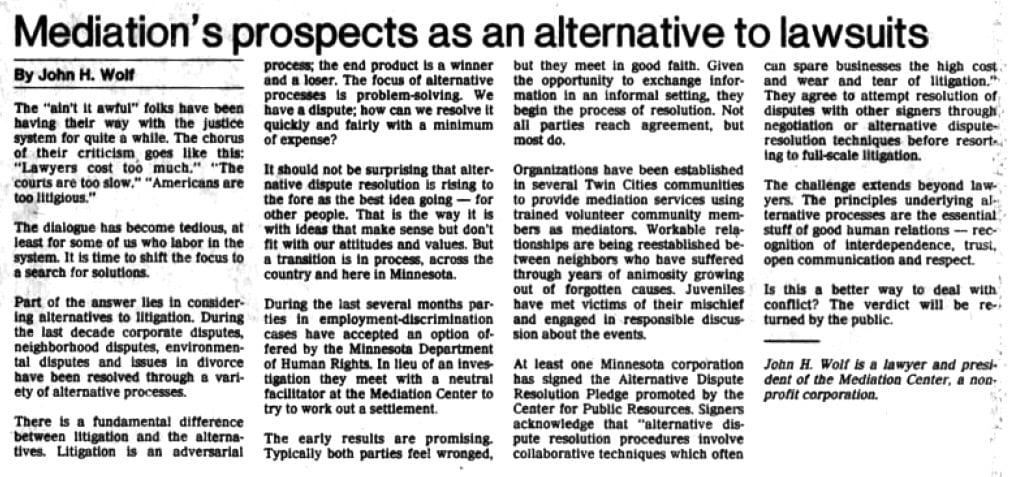
Founding director John Wolf argues for mediation over litigation in an August 1984 op-ed, citing the Center's work with the Minnesota Department of Human Rights and Hennepin County's juvenile courts.
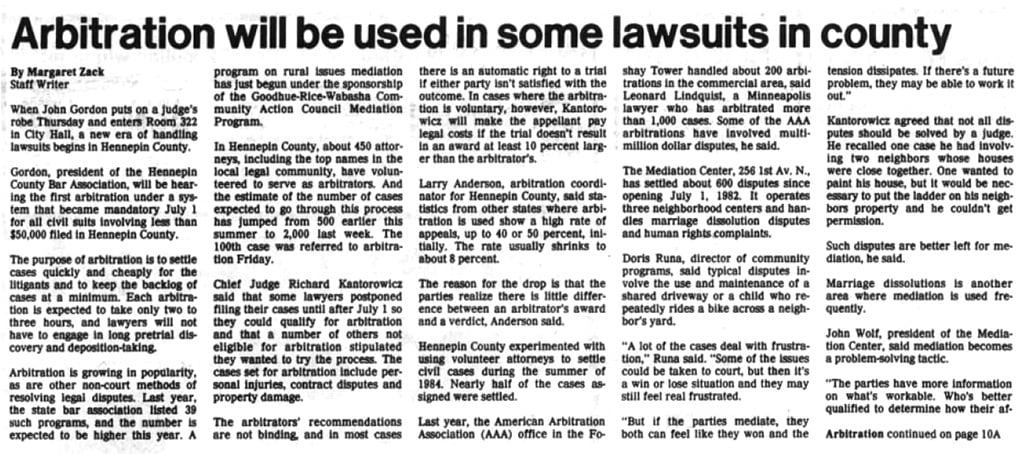
By the mid-1980s, our founder had moved on to start his own practice, and we found ourselves without steady funding, without a stable caseload, and without much certainty about what came next. That is when Bobbi McAdoo, a young lawyer who had left a large Minneapolis law firm to join Hamline University as a law professor, stepped in to lead us. She led the Center from 1984 to 1989. “It was like doing two full-time jobs,” she remembers of those early months. “We were naive but totally determined.”

Founding director John Wolf on the growing use of arbitration and mediation in Hennepin County disputes — Star Tribune, August 1985.
1987
A Turning Point

In 1987, the Minnesota Legislature authorized district court judges to direct civil cases into nonbinding alternative dispute resolution, and the Hennepin County District Court used that authority to send cases over $50,000 to mediation. The Center, working alongside Michael Landrum's Americor, helped train the judges and mediate the county's first cases.

“People were always like, ‘Oh, you mean under $50,000?’” McAdoo recalls. “No, we mean over $50,000.”

It was an unusual bet on a still unproven idea, and we were among the organizations at the center of it, training the judges, preparing the court forms, and mediating the county's first cases, often for free. That work established us as one of the state's leading providers of mediation training, a reputation that only grew when the Minnesota Supreme Court and State Bar convened an ADR task force that same year, with our leadership at the table. This 1987 Joint Task Force on ADR, chaired by Charlie Flinn with McAdoo representing the Center, set the course for the policy decisions that led to what would become Rule 114.

Late 1980s-1990s
National Reputation

Bobbi McAdoo hired Nancy Welsh, who came to us in 1986 from the corporate litigation department at Leonard, Street and Deinard, first as director of mediation services and then as executive director, leading the organization until 1998. Nancy went on to bring in Aimee Gourlay, who joined our team in the early 1990s and would eventually become our CEO.

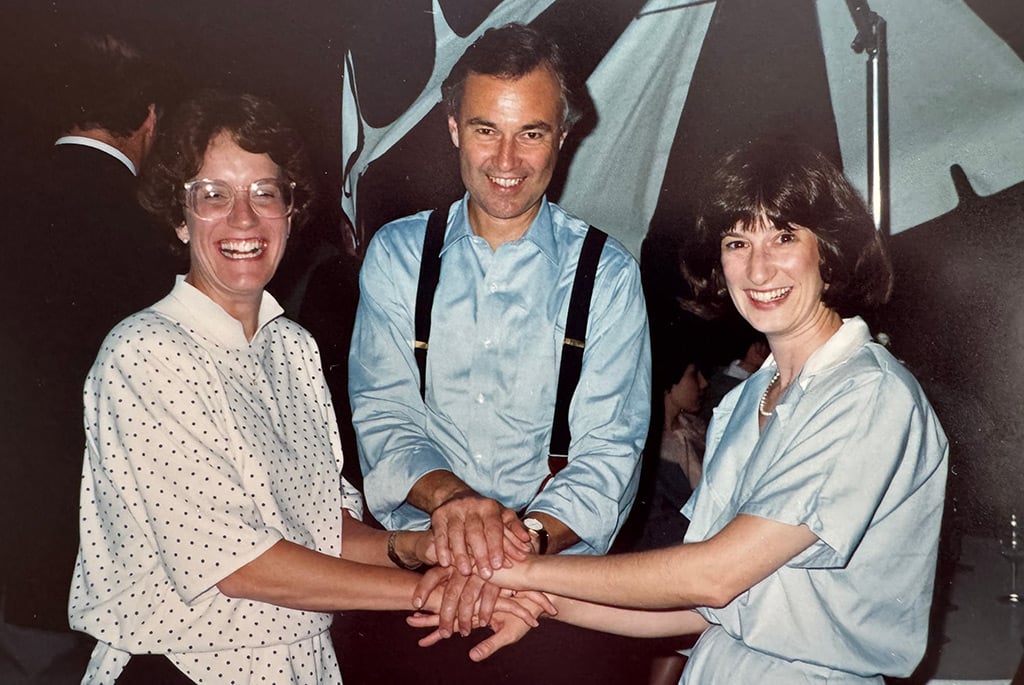
Mediation Center leadership past and present gathered to celebrate a leadership transition as Bobbi McAdoo handed the Executive Director role to Nancy Welsh, joined by the Center’s first Executive Director, John Wolf.

As Rule 114 neared formal adoption, the State Court Administrator's office contracted with us to train the first cohorts of neutrals for the new statewide roster. What followed was a massive statewide training effort, developed and carried out jointly by the Center, with Nancy Welsh as executive director, and Hamline's Dispute Resolution Institute, under Bobbi McAdoo. Eight trainers, among them Welsh, McAdoo, Gary Weissman, and James Coben, traveled the state in twos and threes.

Coben (Jim), a Hamline University law professor who had been drawn into the field by his colleague McAdoo, joined that team in June 1993 and kept at it every couple of months through 1995, delivering what was essentially the same 30-hour training we still teach today. Welsh and McAdoo also built a separate training for judges and court administrators, on which cases to send to mediation and how, and took that around the state as well.

In late 1993, under Nancy Welsh's leadership, we launched one of the more ambitious research projects in our history, setting out to understand how people within the African American, Hmong, and Cambodian communities approached conflict, findings that reshaped mediator training and practice.

The work of the 1987 ADR Task Force culminated in Rule 114, which the Minnesota Supreme Court promulgated in late 1993 and which took effect in July 1994, the court rule that made alternative dispute resolution a routine step in nearly all Minnesota civil cases and that neutrals across the state still practice under today. A 1991 statewide-ADR statute and implementation committee, which included leaders from the Center, carried the task force's work to the Court.

Rule 114 also created a seven-person ADR Review Board, charged with building the statewide roster of qualified neutrals and setting the criteria for who could join it. Nancy Welsh served on that board while she was the Center's executive director, and helped develop the questionnaire the Minnesota Supreme Court used to measure how Rule 114 had changed the practice of law across the state. Bobbi McAdoo, by then directing DRI, served on the board as well and was project director of the evaluation study behind it.

Ken Fox, who had just arrived in Minnesota to direct conflict studies programming at Hamline University, walked into one of our trainings in downtown Minneapolis during his very first week on the job. “It was almost an instant, I think I've come home,” Fox says of that first encounter.

By Fox's recollection, we also administered the arbitration process for the settlement of a major racial-discrimination class action involving Northwest Airlines, with McAdoo and her Hamline law colleague Marilyn Roberts among the arbitrators who heard the individual cases.

Nancy Welsh was named a Leading Minnesota Attorney in 1997. Welsh's standing kept rising: in 2016 she was elected Chair of the American Bar Association's Section of Dispute Resolution.

Nancy Welsh left the Center in 1998. Eduardo Wolle served as director from 1998 to 1999.

2000s
The Hmong Family Mediation Project

By the late 1990s, we saw a chance to put that listening into direct practice. Several tragedies in the Hmong community, including a wave of domestic violence cases, drew heavy news coverage, and a 1998 St. Paul Pioneer Press editorial called on community leaders to make clear that domestic abuse, bigamy, and underage marriage would not be tolerated. We believed mediation could serve as a bridge. Leaders of the Hmong 18 Council, the traditional body that resolves clan and family disputes, sought help from St. Paul city leaders, and Sia Lo, a Hamline law student then volunteering with the Council, connected them with the Center and with Hamline's Dispute Resolution Institute.

In January 2001, a group of respected Hmong community members attended one of our regular family mediation trainings, both to learn the process and to serve as interpreters for a Hmong-specific training to come. Over the following months, Aimee Gourlay, then our director, worked with them to adapt the training for delivery through simultaneous translation and to build support from the judiciary.

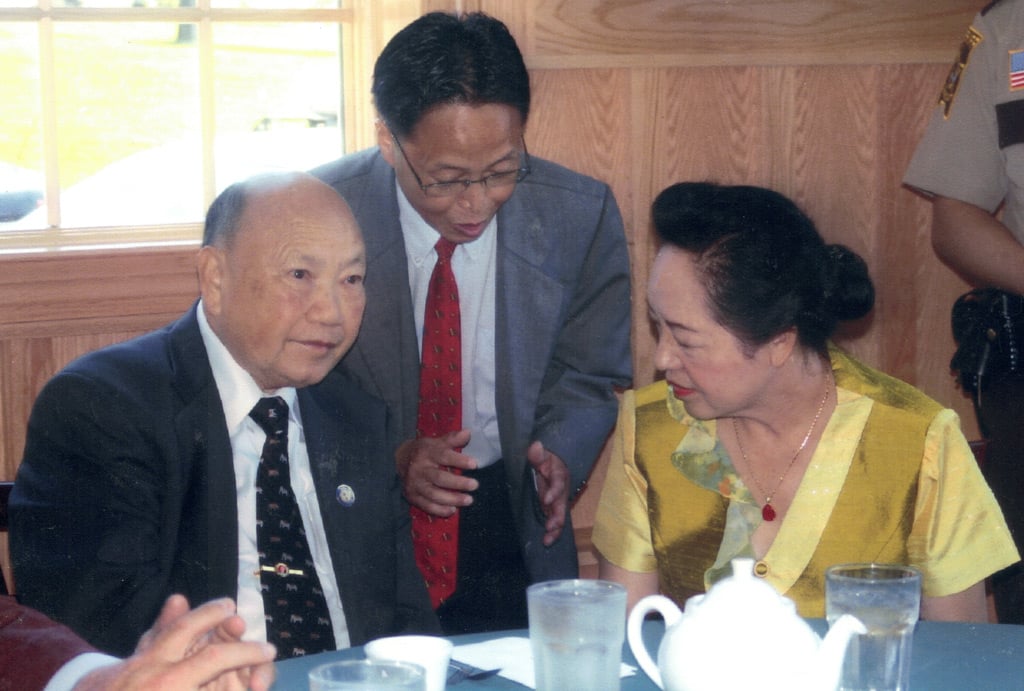
During a June 2010 visit to Minnesota, General Vang Pao (shown here alongside his wife), who led U.S.-backed Hmong forces in Laos during the Vietnam War era, called on Nhia Vue Chu to establish what became the Hmong American Mediation Center in St. Paul.
We delivered the first formal Hmong family mediation training in December 2001, in partnership with the DRI, to an initial group of some thirty Hmong 18 Council leaders, taught by Center trainers, DRI law professors, and Ramsey County judges who were themselves trained mediators. The resulting project helped Hmong families reach agreements that satisfied both a legal divorce under Minnesota law and the cultural expectations of their community.

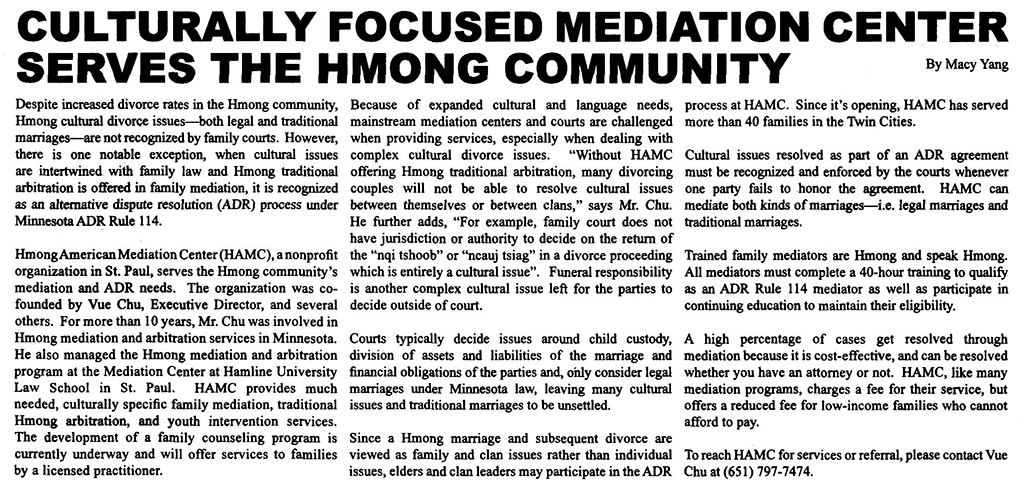
That project grew into an ongoing Hmong mediation and arbitration program that, according to a 2014 profile in the Hmong Times, Nhia Vue Chu went on to manage for close to a decade, until about 2009. In about 2010, after General Vang Pao convened Hmong leaders and asked Chu to organize a mediation center independent of the Hmong 18 Council, Chu co-founded the Hmong American Mediation Center as its own nonprofit organization in St. Paul. The Center trained the new organization's first mediators in 2011 and continues to support its training today.

A 2014 profile of the Hmong American Mediation Center (HAMC) and its co-founder, Nhia Vue Chu, describing the organization's work continuing the Hmong mediation and arbitration tradition the Center helped establish.
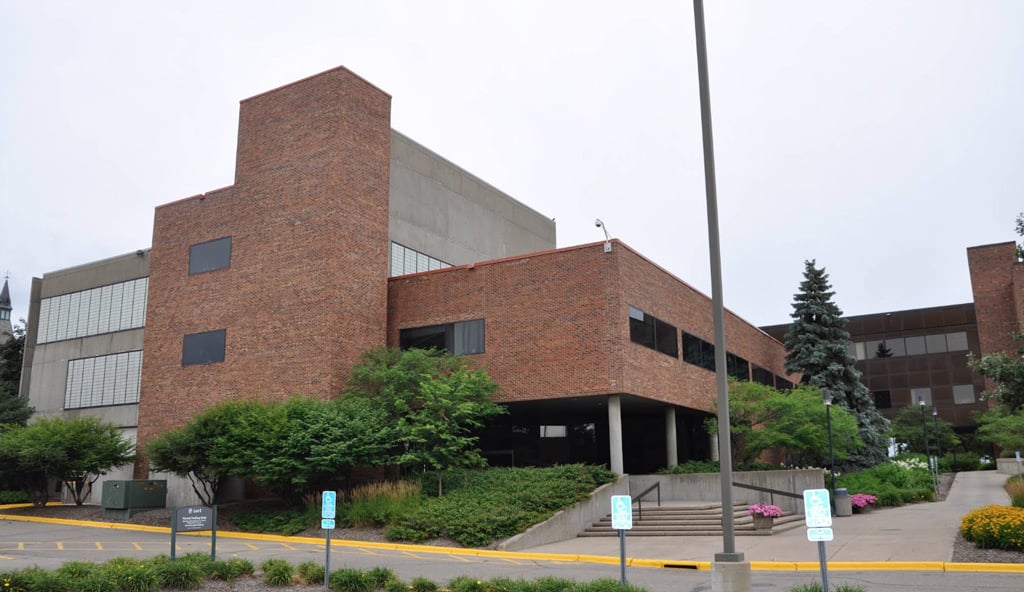
A Home at Hamline

In 1998, we relocated from our downtown Minneapolis office onto the Hamline University campus, entering a formal affiliation with Hamline University School of Law while remaining an independent nonprofit organization.

Hamline University School of Law, home to Mediation Center's operations from the early-to-mid 2000s until the Center's independence in 2013.

In 2002, our original nonprofit corporation was administratively dissolved, and our operations moved fully inside Hamline University School of Law. In January 2008, we and the School of Law agreed to deepen that structure further, with Mediation Center formally serving as the "praxis arm" for DRI's conflict resolution work.

The Mediation Center team collaborates on a project, as pictured in DRI's 2007–2008 annual report.
2010s
Independence and Affiliation

Under Aimee Gourlay's leadership, we separated from the law school and re-established ourselves as an independent organization, a separation formalized in a 2013 affiliation agreement that kept us connected to the school while we operated on our own.

In 2015, when Hamline University School of Law combined with William Mitchell College of Law to form Mitchell Hamline School of Law, we moved into the new school for a time but kept our independence, remaining a separate legal entity even as we stayed affiliated with the new school.

Today
45 Years and Counting

Eventually, we incorporated in 2018 as the private corporation we operate today, while our affiliation with Mitchell Hamline and its Dispute Resolution Institute continues to shape our training and consulting work.

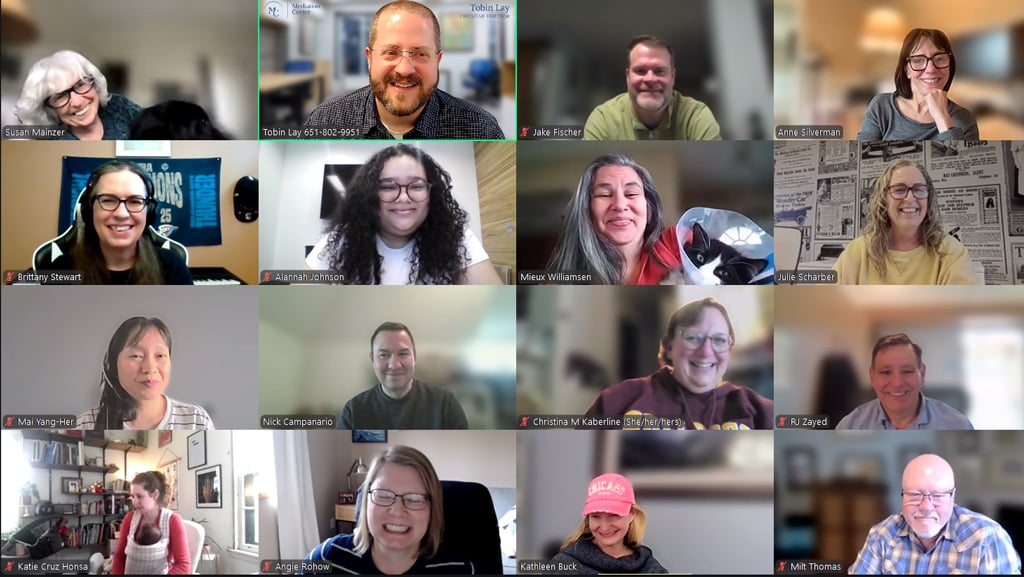
Mediation Center's February 2026 30-Hour Civil Mediation Skills class, held virtually — one of the in-person and virtual trainings the Center continues to offer today.
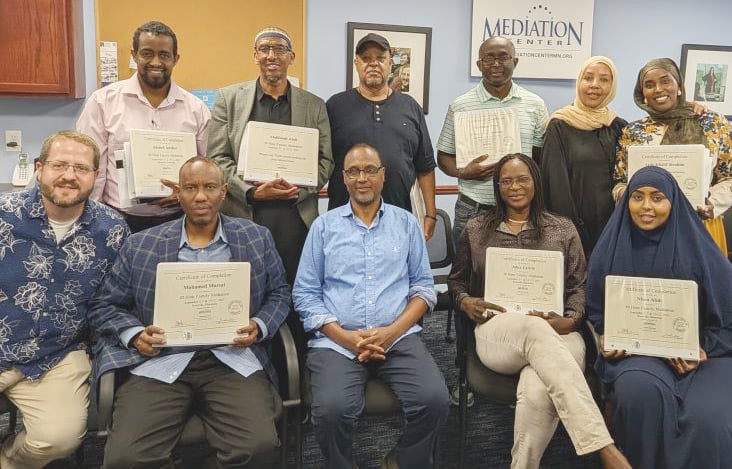
Under Executive Director Tobin Lay, we are leaning further into the training work that has always sustained us and taking on focused, high-impact projects.

Mediation Center continues to bring mediation training to Minnesota's immigrant communities. Pictured: graduates of the September 2025 40-Hour Family Mediation training for leaders of the Twin Cities' Somali and East African communities.
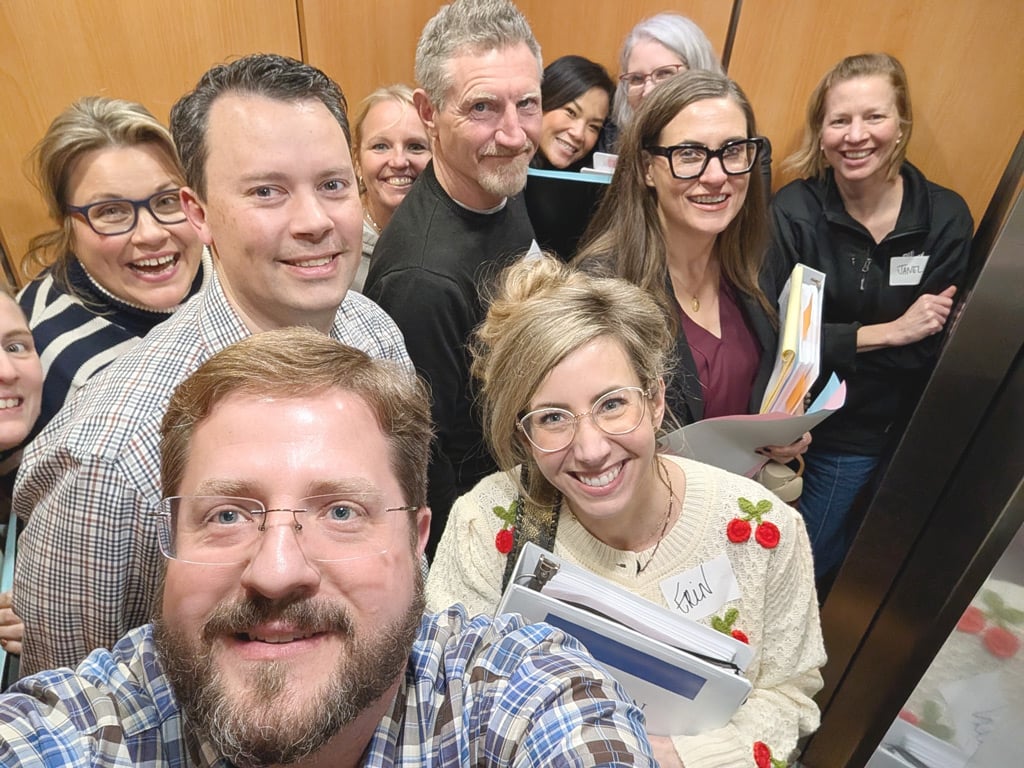
Today, we carry that same 45-year-old mission forward while continuing to evolve with the needs of the people we serve.

Our 30-Hour General Civil Mediation and 40-Hour Family Mediation training remain certified by the Minnesota State Court Administrator ADR Program, and our EVOLVE consulting model helps organizations, nonprofits, and government agencies work through change and conflict before it becomes a crisis.

“How can we use this to solve real life problems?” is the question longtime trainer Coben says has guided us since the beginning, and it still does.

Executive Director Tobin Lay and trainer Jana Deach with students from a February 2026 in-person 40-Hour Family Mediation training, at Mediation Center's current home in Rosedale Tower.

If you’d like to be part of the next chapter of our story, whether through training, mediation services, or organizational consulting, we’d love to hear from you.

Explore our website to learn more, or get in touch here.